
bee watered
Rooted in Indigenous teachings, Bee Watered builds pollinator corridors, restores native habitat, and teaches Tacoma and Pierce County residents how to care for the living systems already around them.
Why Bee Watered
Bee Watered is a community led initiative developed by Native Daily Network to build pollinator corridors and neighborhood based pollinator islands across Tacoma, beginning in South and East Tacoma.
The project brings together native planting, water access, neighborhood stewardship, public education, and youth participation to help people get to know the living city around them. It restores habitat while strengthening the conditions communities need to grow food, care for the land, and support healthier neighborhoods over time.
For years, environmental justice mapping highlighted major environmental and health disparities across Tacoma and Pierce County, particularly in historically underinvested neighborhoods. Past comparisons showed life expectancy gaps measured in decades, including more than 25 years between parts of South and North Tacoma, and 28.1 years between Tacoma’s Lincoln District and nearby Lake Tapps.
Bee Watered does not claim that planting corridors solves these disparities alone. It begins from a simpler truth: the conditions around people matter. Tree canopy, heat, green space, clean air, native habitat, water access, and community stewardship all shape the health of a neighborhood over time. Bee Watered helps rebuild some of those conditions through practical, shared work.
Rooted in the Lakota teaching of Mitákuye Oyás’iŋ, “we are all related,” Bee Watered invites neighbors, youth, local businesses, public agencies, and community partners to take part in restoring relationship with the land and with one another.
How Bee Watered Works
Bee Watered is building a citywide network of connected habitat, water support, ecological learning, and community stewardship. The work begins with existing rain gardens, native plantings, and canopy areas, then expands through new corridor sites, pollinator islands, neighborhood hosts, youth participation, and partner supported stewardship.
Rather than treating habitat as isolated projects, Bee Watered maps existing habitat, rain gardens, canopy areas, waterways, and ecological spaces across Tacoma and its connected spaces to understand where habitat already exists, where systems are disconnected, and where new support or restoration is needed.
Over the next ten years, Bee Watered aims to help establish connected north to south and east to west corridor pathways across Tacoma while supporting smaller neighborhood habitat islands throughout the city and county.
Pollinator Corridors
Bee Watered develops connected pollinator corridors that help bees, butterflies, hummingbirds, moths, beetles, and other pollinating species move through Tacoma.
Corridors may include native plantings, rain gardens, tree canopy, water access points, residential stewardship sites, school projects, and partner supported habitat areas working together as part of a larger living network.
The project works alongside existing infrastructure while also developing new corridor sites where habitat gaps exist. Over time, these pathways help strengthen biodiversity, support urban wildlife movement, and improve ecological resilience across Tacoma and surrounding Pierce County neighborhoods.
Pollinator Islands (POPS)
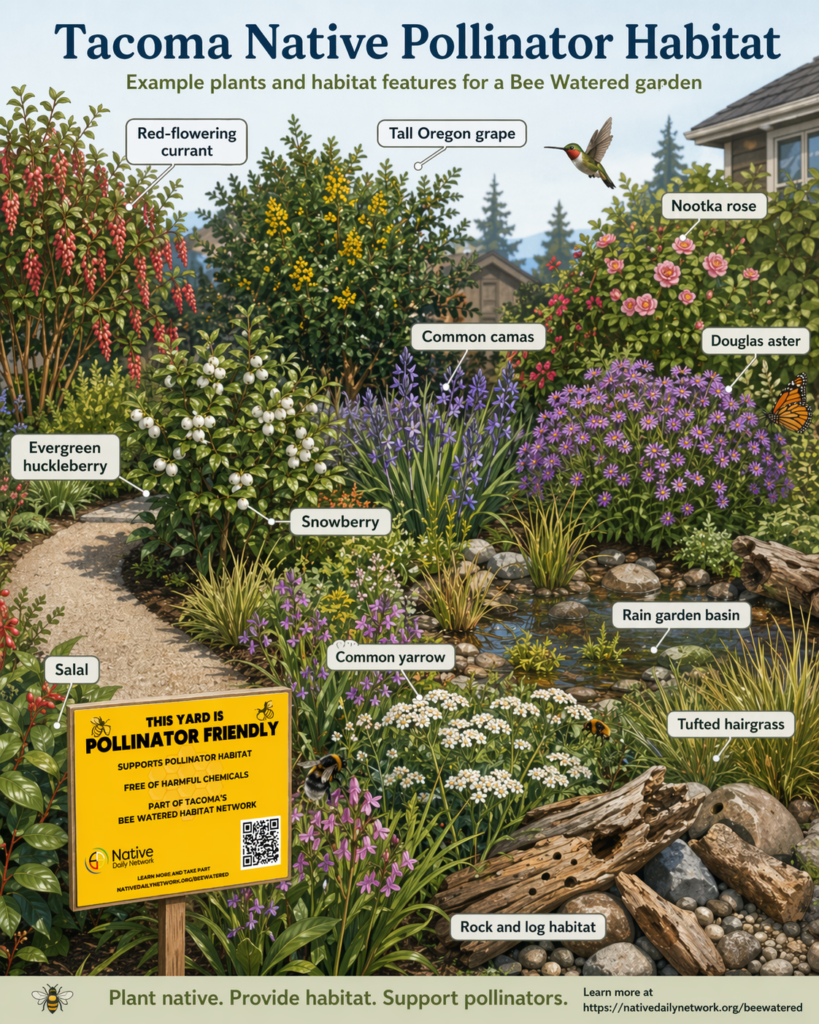
Not every habitat space functions as part of a continuous corridor. Bee Watered also supports Pollinator Islands, also called POPS, or Pockets of Paradise: smaller habitat spaces that strengthen local biodiversity, provide refuge for pollinators and wildlife, and create visible spaces of care within neighborhoods.
Pollinator islands may include school gardens, rain gardens, residential yards, business frontages, community spaces, or existing native plant sites. Some may later become part of a corridor as the network grows, while others remain important local habitat anchors serving their immediate neighborhoods.
Bee Watered will map, recognize, and support these spaces as part of Tacoma’s broader pollinator habitat network.
Shared Stewardship
Bee Watered is built around the idea that healthy habitat requires ongoing community participation and care. Pollinator corridors are not simply installed and forgotten. They depend on neighbors, volunteers, youth participants, hosts, and community partners helping plant, water, observe, maintain, and protect the living systems being created across Tacoma and Pierce County.
By involving residents directly in stewardship, Bee Watered helps strengthen ecological knowledge, neighborhood relationships, and long term care for shared spaces.
This work is not only about restoring habitat. It is about rebuilding relationship with the places people already live.
Community Gatherings
Bee Watered brings people together through Naturehood Walks, education evenings, stewardship days, and partnership events that help neighbors learn what lives here, why habitat matters, and how they can take part.
These gatherings create shared understanding, strengthen relationships, and make the work visible across the community. They also give residents, youth, local businesses, and partner organizations practical ways to participate in building and caring for Tacoma and Pierce County’s growing pollinator network.
Community Learning and Naturehood Watch
Bee Watered combines habitat restoration with hands on ecological learning rooted in Tacoma itself. Through neighborhood walks, stewardship activities, wildlife observation, scavenger hunts, planting events, and community science participation, residents gain a deeper understanding of the ecosystems already present throughout the city.
Naturehood Watch, Bee Watered’s youth participation program, helps young people explore Tacoma’s pollinators, birds, native plants, waterways, and urban wildlife while learning how to actively care for the environments around them alongside local partners and community organizations.
Youth participants will help contribute to stewardship projects, corridor observation, habitat care, wildlife tracking, and cleanup activities connected directly to active corridor and habitat sites. The program will also develop a badge and participation system encouraging long term ecological learning, stewardship, and neighborhood involvement.
Rather than treating nature as something separate from the city, Naturehood Watch helps young people recognize the Tacoma and Pierce County region itself as a living ecosystem shared with countless forms of life.
Water Access and Neighborhood Hosts
Access to water is essential for maintaining healthy pollinator habitat, especially during increasingly hot and dry summer conditions. Bee Watered incorporates neighborhood based water support systems that help sustain pollinator corridors, rain gardens, canopy areas, and habitat sites throughout the city.
Community hosts participate by maintaining small scale water capture systems that support nearby stewardship activities and provide shared water access for volunteers helping maintain corridor sites.
This model helps create shared responsibility for habitat care while strengthening long term neighborhood participation and resilience across Tacoma.
Bee Watered is also developing partnerships with local businesses and organizations to support stewardship through community participation programs, local incentives, and neighborhood partnerships connected to the project.
Complementing Existing Efforts
Bee Watered is built to complement existing work across Tacoma and Pierce County, including tree canopy goals, rain garden infrastructure, Bee City aligned efforts, and the work of local schools, organizations, agencies, and community partners.
The aim is not to duplicate what others are already doing. Bee Watered adds habitat connectivity, water access, stewardship, public education, youth participation, and community mapping in ways that strengthen the broader network of care across the region.
Tacoma Wildlife and Native Plant Mapping
As Bee Watered grows, the project will help develop a long term community driven wildlife and native plant map, documenting pollinators, birds, native habitat areas, canopy conditions, waterways, wildlife sightings, and ecological activity across the city and county.
Through Naturehood Watch, stewardship events, neighborhood observations, and partner participation, residents and youth will help contribute to a growing body of local ecological knowledge rooted in Tacoma itself.
Over time, this mapping system may help support future environmental planning, habitat restoration, canopy development, ecological response efforts, and community science initiatives, and long term stewardship efforts throughout the region.
By helping communities actively observe and understand the ecosystems around them, Bee Watered aims to strengthen long term ecological stewardship while building a deeper shared understanding of local ecology across the 253.
Uniquely 253
Bee Watered is building toward a future shaped by local knowledge, neighborhood stewardship, ecological learning, and shared care for the living systems around us.
Beginning in Tacoma and growing alongside partners across Pierce County, Bee Watered aims to help communities reconnect with the pollinators, native plants, waterways, wildlife, and habitat systems that already exist throughout the region.
Ten years from now, we want young people who grew up in the 253 to recognize the ecology of their own neighborhoods because they helped observe, map, plant, water, and care for them.
This work is built through local participation, public partnership, shared stewardship, and long term ecological learning rooted in place.
The more neighbors, youth, schools, businesses, organizations, and public partners who participate, the stronger our shared ecological future becomes.